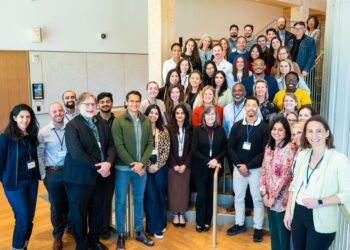
On September 18, 2025, leaders from seven U.S. cities gathered at Harvard University for a hands-on Heat Simulation workshop designed to test their responses to extreme heat — the deadliest climate risk in the United States, killing more people than hurricanes, tornadoes, and floods combined.
The workshop was organized by Data-Smart City Solutions, part of the Bloomberg Center for Cities at Harvard University, in collaboration with CrisisReady and hosted at the Harvard Data Science Initiative. It was held as part of Harvard Climate Action Week 2025, the annual convening sponsored by Harvard’s Salata Institute for Climate and Sustainability. Several cities from Data-Smart’s heat learning cohort sent representatives to simulate a full day of extreme heat, built around a case study of Phoenix, Arizona — the hottest city in the U.S.
A simulation grounded in real events
The 37 city leaders in attendance were seated at six tables by role, each representing a different facet of local government — from Public Works and Utilities to Parks and Transportation. Participants donned colored vests to ground themselves in their simulated roles as Dr. Satchit Balsari of Harvard Medical School and Beth Israel Deaconess Medical Center, co-director of CrisisReady, set the agenda for the day.
The simulation is the first of its kind, built from hundreds of hours of archival news footage from recent Phoenix heatwaves. It moves participants through 29 carefully choreographed sequences that combine audiovisual material, breakout groups, and embedded mini learning modules. Rob Meade, a thermal physiology expert and Salata Institute fellow, explained how heat and humidity affect human health across different time scales. Professor Caroline Buckee of Harvard Chan described the challenges of measuring the impact of both heatwaves and a city’s response, while Balsari and emergency physician Dr. Tess Wiskel guided participants through clinical and public health preparedness.
From insight to action
Concrete, vivid details reshaped how leaders thought about their own systems. Dr. Wiskel described using body bags filled with ice to cool patients in heatstroke during heat emergencies — a detail that prompted cities to rethink everything from supply chains (how do we ensure there’s enough ice?) to EMS protocols (can firefighters ice patients on-scene?).
Balsari pushed participants to look beyond the immediate emergency to longer-term impacts on residents, infrastructure, and utilities — including the novel ways his team collects data and measures heat impacts over time. Residents with pre-existing conditions often present with medical issues in the days following a heat wave, making the cumulative effects of high heat crucial to understand. Energy-cost assistance programs, too, can be a matter of life and death: too often, elderly or low-income residents avoid running air conditioning because of the expense, sometimes fatally.
Crisis management expert Juliette Kayyem of Harvard Kennedy School, a Bloomberg Center for Cities faculty affiliate, offered practical guidance — including a call for cities to review and update their heat-emergency communications strategies.
Cities learning from cities
Participants also shared their own approaches. Beth Graham of Atlanta’s Mayor’s Office of Sustainability and Resilience valued seeing how other cities address the same root issue in locally tailored ways. Chris Osgood, Boston’s Director of the Office of Climate Resilience, came away with a deeper appreciation for the connection between research and on-the-ground work. And Anne Coglianese, Jacksonville’s Chief Resilience Officer, left planning to run her own heat simulation back home: when the simulated power cuts out, she noted, the whole table — public utilities, hospitals, and all — can stop and ask what they would actually do.
As summers grow routinely hotter and longer, extreme heat no longer follows the calendar cycle cities once relied on. Workshops like this one leave participants better informed and readier to act.
This workshop was organized by Data-Smart City Solutions (Bloomberg Center for Cities at Harvard University) in collaboration with CrisisReady, hosted at the Harvard Data Science Initiative, as part of Harvard Climate Action Week 2025.