A new peer-reviewed study from CrisisReady researchers documents a clear and worsening trend: over the past two decades, wildfires in California have been steadily encroaching on the perimeters of healthcare facilities. The paper, “Proximity of Wildfires to Inpatient Healthcare Facilities in California, 2001–2023,” was published in AGU GeoHealth and authored by Caleb Dresser, Neil Singh Bedi, Andrew Schroeder, Eric Sergienko, and Satchit Balsari.
The finding
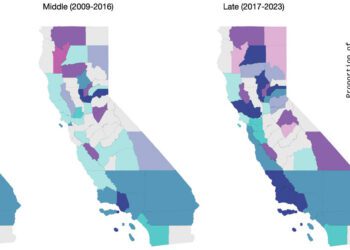
It’s not your imagination. Using annual data from the California Department of Health Care Access and Information and CAL FIRE’s Fire and Resource Assessment Program, the team conducted a retrospective spatial analysis measuring the distance between every inpatient facility in the state and the nearest wildfire perimeter, year by year, across 23 years. The headline result: the distance from inpatient healthcare facilities in California to nearby wildfires is decreasing by an average of 628 feet per year, while close approaches are increasing. Recently constructed facilities experienced a disproportionate number of these close approaches. medRxiv
Why it’s happening
The trend reflects two compounding forces. The first is rapid climate change and environmental shifts at the wildland-urban interface, which are reshaping where and how intensely fires burn. The second is changing development patterns, as new settlements — and the healthcare facilities that serve them — are built further out into wildfire-prone country. The cumulative effect is a drastically changed risk landscape for healthcare professionals, who increasingly find themselves on the front lines of major disasters.
Why it matters
Hospitals and other inpatient facilities serve some of the most vulnerable people in any community, and they are difficult and dangerous to evacuate. As fires draw closer, the case grows for centralizing long-term wildfire preparedness, adaptation, and response planning into the core curriculum and operational planning of health professionals. This is a story of both long-term changes in wildfire conditions and the siting decisions behind recently opened facilities — and the authors argue that concrete action to address the escalating risk is urgently needed.
The underlying data and analysis code are publicly available, so healthcare professionals in California can examine trends for their own region or facility in more detail.
This research was conducted by CrisisReady in partnership with Direct Relief, with collaborators from Harvard, Beth Israel Deaconess Medical Center, and Boston University.
Read the full paper in AGU GeoHealth: https://agupubs.onlinelibrary.wiley.com/doi/10.1029/2025GH001531
Access the underlying dataset on Harvard Dataverse: https://doi.org/10.7910/DVN/MODVUK